

SAFETY & AWARENESS
- Home
- /
- Rack Safety Signs & Loading Charts
Rack Safety Signs & Loading Charts
Know the load.
Follow the sign.
Protect the warehouse.
Rack safety signs and loading charts help ensure your storage system is used within its designed limits — reducing risk, preventing damage, and supporting safer warehouse operations.

Rack Safety Signs & Loading Charts: Why They Matter
Warehouse racking is a structural storage system, not just shelving. Every installation is designed for specific load capacities, pallet types, beam levels, and operating clearances.
Rack safety signs and loading charts communicate those limits clearly so the system can be used safely and correctly.
At Palian, we supply rack safety signs as part of responsible warehouse safety practice.
They help clients, supervisors, forklift operators, and safety teams understand the design limitations of the installation and reduce the risk of misuse.
Why We Supply Rack Safety Signs
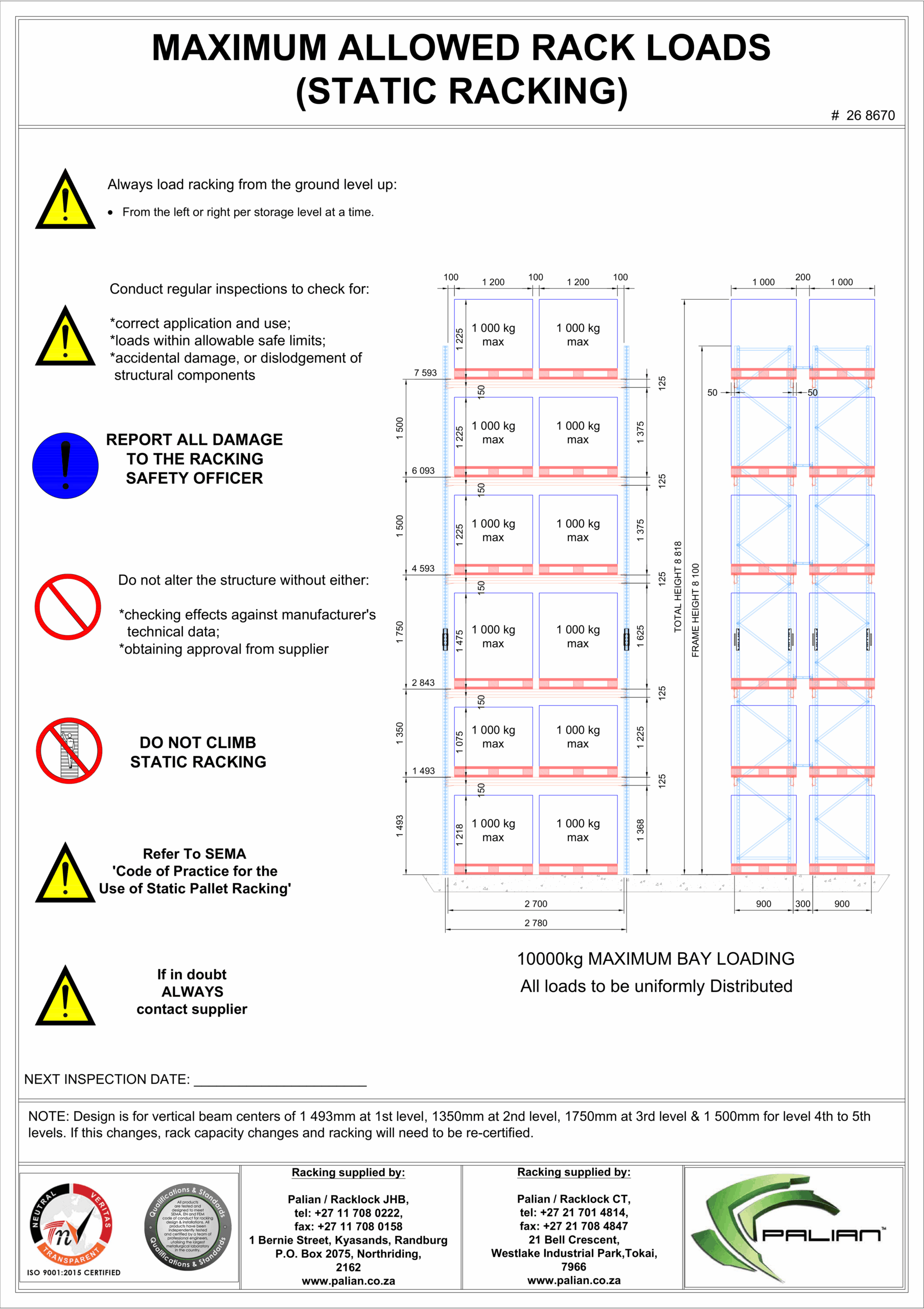
Rack safety signs serve a simple but essential purpose: they make critical load information visible at the point of use.
Without clear signage, operators may not know:
- how much weight each beam level can carry
- the maximum bay load
- what pallet size the system was designed for
- whether the rack configuration has been altered from its approved design
This creates unnecessary risk.
By supplying rack safety signs, we help clients:
- improve day-to-day warehouse safety
- support safe loading practices
- reduce the chance of overloading
- promote operator awareness
- reinforce compliance with the original rack design
Why Loading Charts Must Be Followed
A loading chart is not a suggestion. It reflects the operating limits of the racking system as designed.
When loads exceed the specified limits, or when pallets are used incorrectly, the rack may be exposed to stresses it was not designed to handle. This can lead to:
- excessive beam deflection
- frame overload
- damage to uprights and connectors
- reduced structural stability
- falling goods
- product loss
- injury to personnel
- operational downtime
Even small departures from the intended loading method can create cumulative damage over time.
“A loading chart is not a suggestion. It reflects the operating limits of the racking system as designed.”
Common Problems
Common Unsafe Practices
Unsafe rack use often starts with routine shortcuts. These are some of the most common problems seen in warehouse environments.
Nudging one pallet with another to realign loads
Positioning pallets against uprights or beam end connectors
Need for maintenance planning
Moving beam levels without supplier approval
Continuing to use racking after impact damage
These practices introduce additional forces into the structure and increase the likelihood of damage or failure.
Safe Racking Use
Key Operating Principles for Safe Rack Use
Warehouse racking systems are load-bearing structures. For qualifying larger installations, qualified engineering input and formal certification provide added confidence in the approved structural solution.
Use Racking Only for Its Intended Purpose
Racking must be used according to its design parameters and original operating conditions.
Use the Correct Pallets
Only the correct pallet weight, type, and size should be used. From your checklist, the referenced pallet specification is:
4-way entry pallets
Maintain Load Stability
Goods on pallets must be stable, secure, and properly positioned. Loads should never lean, shift, or slump in storage.
Maintain Operating Clearances
Adequate clearances help reduce impact risk and improve safe forklift handling. Your checklist references:
100 mm minimum between top of pallet and bottom of beam
Never Slide Pallets into Place
Pallets should be lowered carefully using the correct MHE. They must not be slid, dragged, or forced into position.
Do Not Alter the Racking Without Approval
Beam levels and structural components must not be changed without supplier approval and written confirmation of safety.
The Risk of Unauthorized Changes
One of the most overlooked rack safety issues is altering beam levels or configuration after installation.
What appears to be a small change can affect:
- maximum frame load
- load distribution
- structural stability
- safe clearances
- overall compliance with the approved design
Any modification should be reviewed and approved in writing before changes are made.
Any modification should be reviewed and approved in writing before changes are made.
Who Benefits
Who Benefits from Rack Safety Signs?
Identify these issues early. Visible damage to racking or shelving should never be ignored — it is a safety issue, not a cosmetic one.
Warehouse managers
Better control over safe storage practices.
Forklift operators
Visible loading guidance at point of use.
Safety officers
Clearer monitoring and enforcement.
Operations teams
Reduced avoidable damage and downtime.
Business owners
Lower safety exposure and better asset protection.
What Clients Should Do Regularly
To keep racking safe and compliant in practice, clients should:
Identify issues before they become operational problems or downtime events.
Train operators to understand loading charts
Inspect pallets before use
Avoid unapproved changes to beam levels or bay configuration
Review load compliance during routine warehouse inspections
Review load compliance during routine warehouse inspections
Protect Your People, Product, and Operation
If your rack safety signs are missing, damaged, outdated, or no longer reflect the current installation, the system should be reviewed.
Speak to Palian about rack safety signage, inspections, load verification, and responsible warehouse storage practice.
Contact us for a rack safety assessment or signage review.