

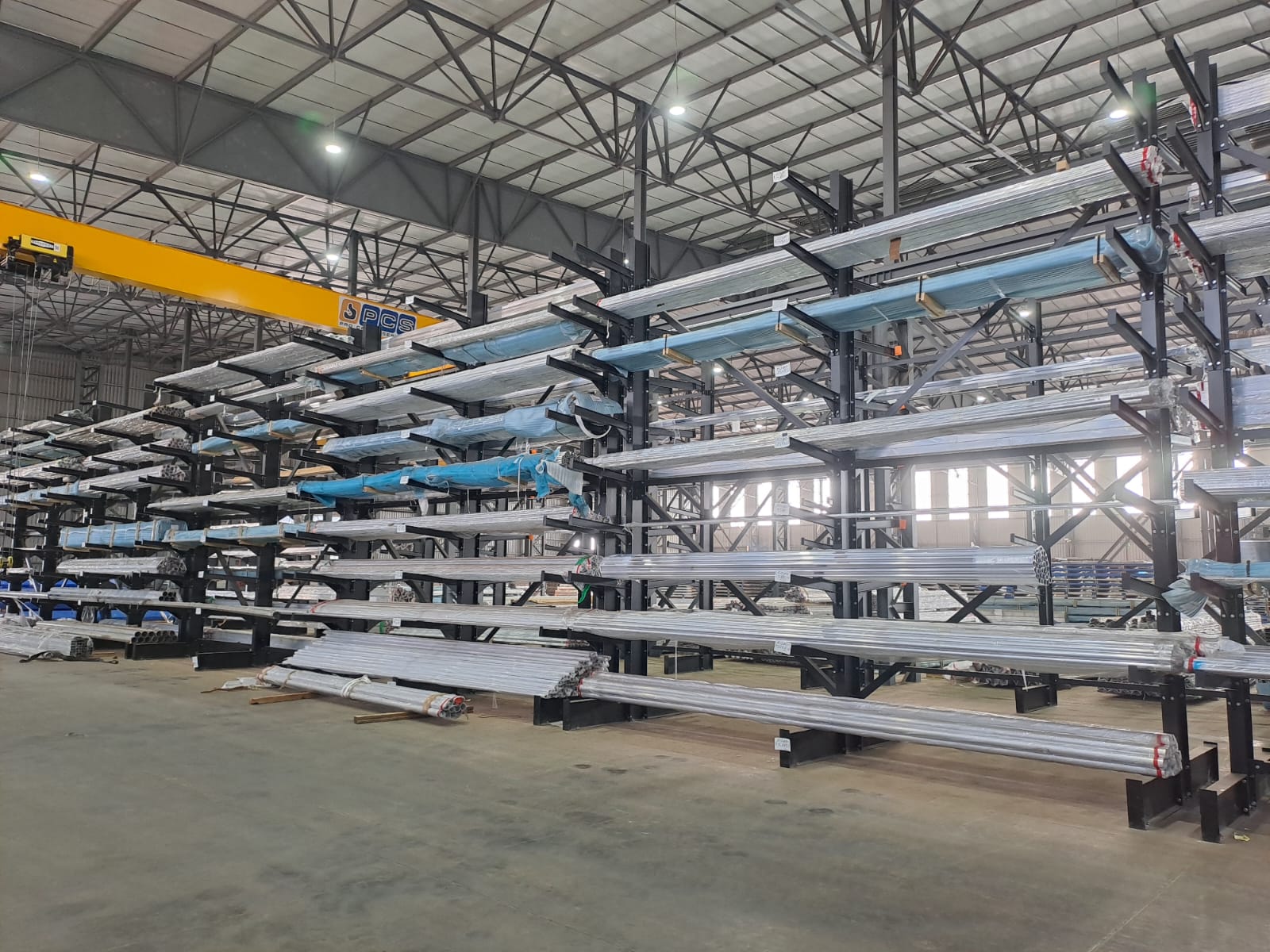
The Advantages of Cantilever Racking for Long and Bulky Item Storage
Some items simply do not fit conventional storage. Timber lengths, steel bar stock, piping, rolled materials and large panel products are too long, too awkward, or too heavy for standard pallet racking or shelving to handle safely. Cantilever racking exists to solve exactly this problem, using open-front arms instead of upright frames so oversized items can be stored, accessed and retrieved without obstruction.
What Is a Cantilever Rack?
A cantilever rack is a storage system built around vertical columns anchored to a solid base, with horizontal arms extending outward to carry the load. Unlike pallet racking, there are no front uprights or cross-bracing in the way, so items can extend beyond the arms in either direction.
Cantilever racking comes in single-sided and double-sided configurations. Single-sided systems are typically used against a wall or boundary, while double-sided systems place arms on both faces of the same upright, doubling storage capacity within the same footprint. For a closer look at how the system is engineered, our article on what cantilever racking is covers the structural basics in more detail.
Why Cantilever Racking Suits Long and Bulky Items
No Front Obstructions
Pallet racking uprights create a hard limit on how long an item can be before it no longer fits safely within a bay. Cantilever racking removes that limit entirely, since there is nothing at the front of the rack to obstruct length. This makes it the standard choice for timber, steel sections, piping, rolled carpet and textiles, and similarly shaped stock.
Direct, Unobstructed Access
Because the front of the rack is completely open, forklifts and cranes can approach from either side without reversing between frames or navigating around fixed structure. This speeds up loading and unloading and reduces the risk of items being knocked or damaged during handling.
Our article on why choose cantilever racking explains this accessibility advantage in more depth.
Handles a Wide Weight Range
Cantilever racking is not limited to light goods. Depending on arm length, upright specification and base design, systems can be engineered to carry loads ranging from light stock through to heavy structural steel and industrial equipment. This flexibility is one of the reasons cantilever racking is used across such a wide range of industries.
Adjustable for Changing Stock
Arms can be repositioned or added to suit new product dimensions, so a single system can accommodate mixed stock types, such as timber alongside steel tubing, without needing a full redesign. This adaptability matters for businesses whose product range shifts over time.
Suitable for Indoor and Outdoor Use
Cantilever racking performs equally well inside a warehouse or outdoors in a yard, provided the finish is specified correctly. Galvanised steel is the standard choice for outdoor systems exposed to rain, humidity or coastal air.
Our article on why choose galvanised racking explains how the right finish extends the working life of an outdoor installation.
What Items Are Best Suited to Cantilever Racking?
Cantilever racking is used across manufacturing, construction supply, timber merchants, steel suppliers and general warehousing for items such as:
- Structural steel beams and bar stock
- Timber, lumber and roof trusses
- PVC, copper and steel piping
- Rolled carpet, textiles and vinyl
- Sheet materials such as drywall, plasterboard and flake board
- Wire and cable coils
- Large or irregular equipment components
Items that specifically need long and bulky item storage benefit most from cantilever racking’s open design, since these are the products traditional pallet racking and shelving handle poorly.
Roll-Formed vs Structural Cantilever Racking
Most cantilever systems are built using roll-formed, boltless steel components, which are lighter, quicker to install and more cost-effective for general use. This covers the majority of applications, including timber, piping and standard steel stock.
For very heavy or oversized loads, such as large machinery components, structural cantilever racking uses welded structural steel sections instead. This delivers higher load capacity and greater rigidity at a higher cost, and is typically specified only where roll-formed systems would not provide sufficient strength.
Key Components of a Cantilever Rack
| Component | Function |
|---|---|
| Base | Anchors the system to the floor and provides the primary stability for the structure. |
| Upright Columns | Vertical supports connected to the base, determining the height of the system. |
| Arms | Horizontal members that extend from the uprights to carry and support the stored load. |
| Bracing | Straight or diagonal bars connecting uprights, adding rigidity and increasing overall load capacity. |
Understanding these components helps when specifying a system, since arm length, base size and bracing configuration all need to match the products being stored.
Choosing the Right Cantilever Racking System
Load Weight and Arm Capacity
Arm capacity must be matched to the heaviest items intended for storage, with an appropriate safety margin built in. Our article on warehouse racking load limits explains how these ratings are calculated and why they should never be estimated by eye.
Arm Length and Spacing
Longer items need longer arms and adequate spacing between bays. Mixed stock types may require variable arm lengths within the same run of racking.
Indoor or Outdoor Installation
Outdoor systems generally require a galvanised finish and, in some cases, a weather protection canopy over the top arms to prevent corrosion and structural strain over time.
Compliance and Certification
Cantilever racking, like all industrial racking, should be engineered and certified to recognised structural standards. Our article on why pallet racking needs to be certified applies equally to cantilever systems and is worth reviewing before installation.
Ongoing Inspection
Outdoor exposure and heavy forklift traffic place extra strain on racking components over time. Our article on the importance of regular racking inspections and maintenance covers how to identify bent arms, corrosion or base movement before they become safety issues.
Cantilever Racking for the Construction Industry
Construction suppliers and contractors are among the heaviest users of cantilever racking, given the volume of steel, timber and piping moving through their yards and warehouses. Our dedicated article on cantilever racking for the construction industry looks specifically at that use case, including outdoor site storage and material handling on active sites.
Why Choose Palian for Cantilever Racking
Palian designs and manufactures cantilever racking locally in South Africa, meaning shorter lead times, direct technical support, and systems engineered for South African conditions rather than imported specifications built for other climates.
Every system is designed to recognised structural standards and can be specified in roll-formed or structural configurations, with galvanised or powder-coated finishes for indoor and outdoor environments.
Whether stock consists of timber, steel, piping or other long and bulky items, the right cantilever system comes down to load requirements, arm configuration and the environment it will operate in.
View our cantilever racking product range to see specifications and configurations, or contact Palian for a tailored quotation or expert advice on the right system for your operation.
Frequently Asked Questions
What items are best suited to cantilever racking?
Long, bulky or irregularly shaped items such as timber, steel bar stock, piping, rolled carpet and sheet materials are best suited to cantilever racking, since they do not fit efficiently on conventional pallet racking or shelving.
What is the difference between roll-formed and structural cantilever racking?
Roll-formed cantilever racking uses lighter, boltless components suited to most general applications, while structural cantilever racking uses welded steel sections for higher load capacity, typically for very heavy or oversized items.
Can cantilever racking be used outdoors?
Yes. Cantilever racking can be manufactured with a galvanised finish and, where needed, a weather protection canopy, making it suitable for outdoor yards exposed to rain and humidity.
What is the difference between single-sided and double-sided cantilever racking?
Single-sided racking has arms on one face only and is typically used against a wall or boundary, while double-sided racking has arms on both sides of the upright, maximising storage in open floor or yard space.
Does cantilever racking need to be certified in South Africa?
Yes. Like all industrial racking, cantilever systems should be engineered and certified to recognised structural standards to ensure they are safe under load and compliant with workplace safety requirements.