

What Is Pushback Racking & Is It Right for Your Warehouse?
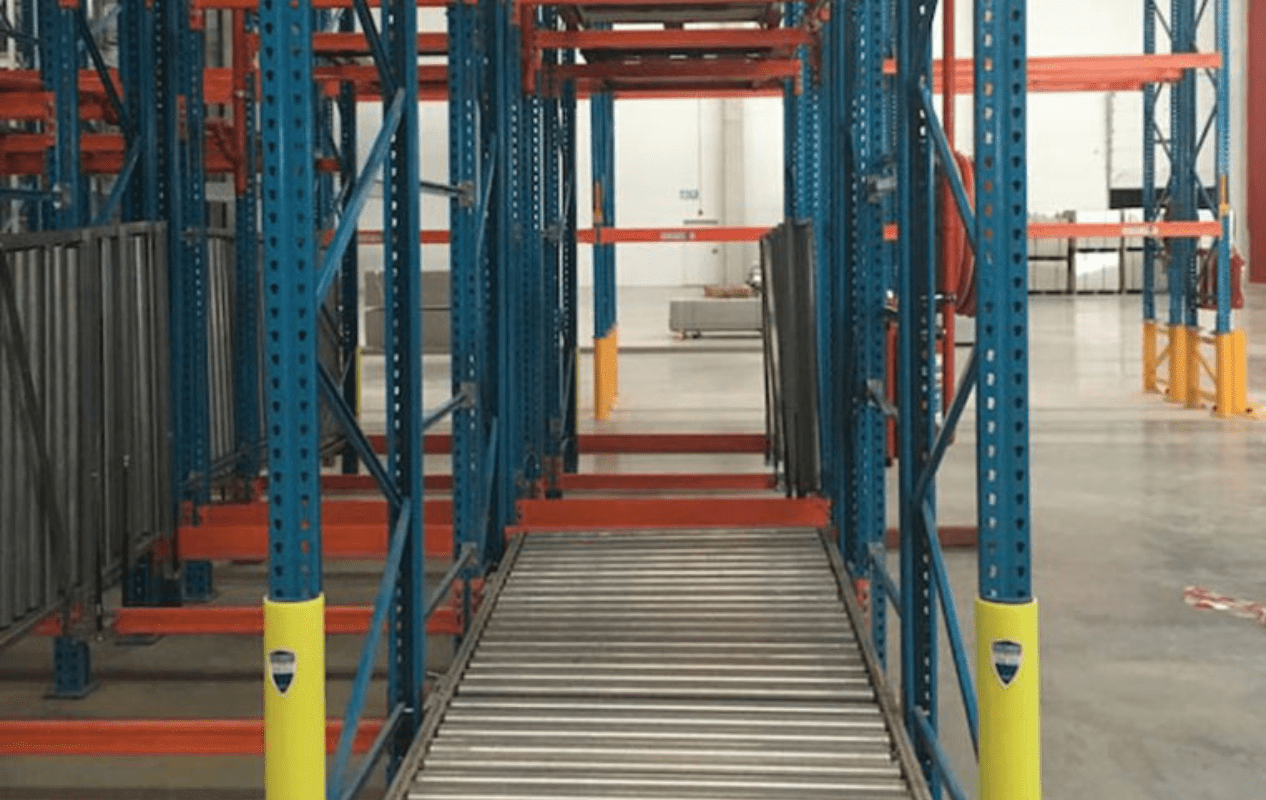
Pushback racking is a high-density pallet storage system that allows pallets to be stored two to six deep on either side of a single aisle. Pallets sit on a set of nested carts that run on inclined rails. When a new pallet is loaded at the front, it pushes the existing pallets backwards along the rails. When the front pallet is removed, gravity automatically advances the remaining pallets, presenting the next pallet at the pick face.
This means your forklift operator never needs to enter the racking lane. All loading and picking happen from the same aisle face, which is one of the key reasons pushback is faster and safer to operate than drive-in racking.
How Is Pushback Racking Different from Drive-In Racking?
This is the question most warehouse managers ask first because the two systems look similar from a distance but work very differently.
With drive-in racking, the forklift physically enters the racking lane to place or retrieve pallets. Pallets rest on continuous rails inside the lane. It operates on a Last-In, First-Out (LIFO) basis, meaning the last pallet loaded is the first one out.
Pushback is also LIFO, but the forklift never enters the lane. Instead, the pallet carts do the work, rolling back on inclined rails as new pallets are loaded and rolling forward as pallets are retrieved. This makes pushback significantly safer than drive-in, faster to operate and gentler on the racking structure itself.
| Pushback Racking | Drive-In Racking | |
|---|---|---|
| Forklift enters lane | No | Yes |
| Stock rotation | LIFO | LIFO |
| Depth per lane | 2 to 6 pallets | 2 to 10+ pallets |
| Speed of operation | Faster | Slower |
| Risk of racking damage | Lower | Higher |
| Cost | Higher | Lower |
| Best for | Medium turnover, multiple SKUs per level | Low turnover, single SKU per lane |
How Deep Can Pushback Racking Go?
Standard pushback systems accommodate two to six pallets deep per lane. This is shallower than drive-in racking, which can go much deeper, but the trade-off is speed and selectivity.
If you need storage deeper than six pallets, shuttle racking is worth considering. Shuttle systems can go much deeper and still operate without a forklift entering the lane, using a motorised shuttle carrier to retrieve pallets.
What Products or Operations Is Pushback Racking Best Suited For?
Pushback racking works best when:
- You store medium-turnover products.
- You have multiple SKUs to store at high density.
- LIFO stock rotation is acceptable.
- You want to reduce forklift travel time.
- You are dealing with non-stackable pallets.
For operations that require FIFO rotation, pallet live storage or carton flow systems may be more suitable.
What Are the Disadvantages of Pushback?
No racking system is right for every operation. Pushback racking has limitations worth understanding before you commit.
- LIFO only.
- Limited depth compared to drive-in or shuttle systems.
- Higher upfront cost than drive-in racking.
- Requires consistent pallet dimensions.
How Much Space Does Pushback Save Compared to Standard Racking?
A warehouse using conventional adjustable pallet racking needs a dedicated aisle for every row of racking. Pushback racking stores two to six pallets deep on each side of a single aisle, dramatically reducing the number of aisles needed.
Depending on your layout and depth configuration, pushback racking can increase storage capacity by 25% to 55% compared to a standard single-deep racking layout within the same footprint.
How Does Pushback Racking Compare to Mobile Racking?
Mobile racking is another high-density system that eliminates static aisles, but the two systems work quite differently.
Mobile racking moves entire rows of conventional racking along motorised floor tracks, creating a single aisle that moves to wherever access is needed. Pushback does not move the racking itself. The pallets move within fixed lanes.
For a broader comparison of available systems, read How Can I Choose the Right Racking System for Heavy Industrial Use?.
What Should I Check Before Specifying Pushback Racking?
Before committing to pushback , consider:
- Your pallet size and weight.
- Your average SKU count per aisle.
- Whether your stock requires FIFO rotation.
- Your forklift equipment capabilities.
- Your available ceiling height.
How Do I Get Pushback Installed in South Africa?
Palian designs, manufactures and installs pushback systems across South Africa. Every installation starts with a site assessment to understand your space, pallet types, SKU profile, forklift equipment and operational requirements.
You can view our pushback racking product page for a specification overview or read The Versatility and Efficiency of Pushback Racking for more detail on the operational benefits.
To discuss your requirements or request a quotation, contact the Palian team.
Frequently Asked Questions
How does pushback racking work?
Pallets are placed onto nested carts that sit on inclined rails inside the racking lane. Each new pallet loaded at the aisle face pushes the carts and existing pallets further back along the rails. When a pallet is removed from the front, the carts roll forward under gravity, presenting the next pallet automatically. All loading and picking is done from a single aisle face
What is the maximum depth of pushback racking?
Standard pushback racking systems store two to six pallets deep per lane. If you require greater depth, shuttle racking can go considerably deeper while still operating without the forklift entering the lane.
What type of forklift is needed for pushback racking?
A standard counterbalanced forklift or reach truck is suitable for pushback racking, provided it can reach the required height and handle the specified pallet load. Because the forklift never enters the lane, there are no special mast or width requirements beyond standard operating clearances.
Can pushback racking be relocated if I move warehouse?
Yes. Pushback racking is a free-standing system and can be dismantled and reinstalled in a new facility. The cart and rail components are reusable provided they are in good condition, though the system will need to be re-engineered and re-certified for the new location.